Kid’s menu.

There are few domestic tasks that also allow for as much creativity, skill and pleasure than cooking. You can execute a chore; put a few ingredients together to create a simple meal with minimal preparation and flair. Or you can turn a meal into an event; an experiment in flavours, presentation, culture and indulgence. Or anything in between.

Taking a kid into the kitchen is an adventure. As dads, we get to show off our skills, ensuring the next generation carries forward any delicious habits we’ve honed over the years. But if you’re inviting kids into your kitchen to help, prepare to have inexperienced little hands doing the helping.

Here are a few things I’ve learned, and a few of the special tools that make your time a little easier, and a lot more fun. One disclaimer, though: I am not a chef. I am not even a cook. So take this advice as a ‘Really-Cool-Dad-who-tries’. With a grain of salt, as they say.

The Basics
As a general rule, you should buy the best quality equipment and ingredients you can afford. There are some items (such as wooden spoons) that trick you into paying for style rather than substance, but often there is a real advantage to paying for better quality. As for food, fresh and local are good rules. Explore a market with your kid; a market owner who loves to share their knowledge with children is a good clue that they care about their product and their customers.

Cookware
Let’s assume you have the basic set of sturdy pots and pans. That’s good. Depending on how strong your kids are, you may look at getting a few extra pieces that are smaller and lighter. If you’ve ever tried to lift a large cast iron pan, you know that it can be tricky even for an adult. The compromise on heat quality won’t be an issue, and the kids will get more chances to be involved.

Knives.
Knives are dangerous. Knives are powerful. Knives are cool. Knife skills are the benchmark of respect in a kitchen, and it takes practice. Lots and lots of practice.

Your 8” chef’s knife is your best friend in the kitchen. Invest in a good one and take care of it. You should also make sure you have a good paring knife, one that their little hands can manipulate easily. Learning how to handle these two knives safely is important for kids.

Here’s the challenge: sharp knives are safer. While it may seem backwards to keep the knife sharp for little hands, dull knives slip easily, creating nasty opportunity to miss the mark and slice into a finger or two (or worse). And they cut poorly, making it frustrating and not fun. Teach your child to respect the knife with proper holding, cutting and storing techniques.

Only you will know when you can trust your little kid with a knife. Like many things, it will probably be sooner than you would like.

The iconic KitchenAid™ mixer.
Mixing. Whipping. Kneading. Licking the beaters. What else can I say?

Pasta roller/cutter
Making fresh pasta is easy, and kids are always excited to eat the results. It’s easy to use, and will last a lifetime if you take care of it. A basic, fresh tomato sauce is fine at first, but different shapes allow a kid to experiment with different sauce textures and tastes. You can make green pasta and red pasta, paring it with sauces in exciting ways. Stuffing pasta takes a little more patience, but it’s a good step forward when linguine becomes a little too routine.

Pizza stone
We use both an air tray and a pizza stone. The air tray cooks the pizza through and gets a thicker, sturdy crust, then we transfer to the stone to crisp it up. Cooking with the stone takes the pizza from good to amazing.

Pizza is big round taste experiment. Get creative; it’s easy for everyone to make their own combination and then share the results. While I won’t ever pretend that pizza is actually a health food, it’s easy to get vegetable into the mix.

Peeler
This should be one of the easiest tasks to get little ones helping. Get a peeler that fits comfortably in little hands so they can learn good technique. (I’ve heard the Y shaped peelers are easy and effective, but I haven’t used one yet.) (UPDATE: We finally bought and tried the Y shaped option. I didn’t like it. I’ve bought a classic straight one, again.)

Measuring
Get devices that are easy to handle and easy to read. As adults, we can have lots of complicated multi-function devices, but these can be confusing to new cooks. Simple, basic sets help kids understand the task at hand without having to decipher a cook’s codes.

Herbs & Spices

Different cultures use different spices as staples, so go exploring and talk with friends. Spices add an intensity of flavour, or combine to create taste profiles that shifts food from bland to wow. Taste is a sense that actually develops as we grow older, so if your child doesn’t like something today, don’t despair. You can try again soon enough.

Keep in mind that most herbs are also pretty easy to grow in the smallest of gardens, so fresh versions are an option.

Eggs
Kids love to break eggs. Even if they aren’t helping you with anything else, call them into the kitchen to break the eggs. Be prepared for accidents, so break and separate into a bowl before adding them to recipes.

Practice
Give yourself lots of time to prepare a meal with a kid. Make a habit of getting all the ingredients ready before you start anything, and plan to waste a bit of food while learning to cook. Things will get broken or squished or dropped or burnt. It’s okay.

Get used to eating imperfect dishes and “unique” flavours. Nothing is more discouraging to a young chef than making something nobody wants to eat, so be ready for anything.

Clean
Always keep your kitchen clean. A clean space is safer, easier to work in, and healthier for everyone. Don’t wait until the end of the meal to clean the kitchen. Take advantage of little moments to get rid of trash, tidy your tools and prepare for the next step. Whether you use microfibre cloths and water, or industrial strength bleach and disinfectants, be sure to understand how to handle food safely and keep your hands and work surfaces clean.

Cooking with kids can be fun and rewarding. It takes little more time and a lot more planning, but it is something you can do everyday, and a skill they will use for the rest of their lives.

What have you learned about cooking with kids?
Posted in Adventures, Cooking, Food | Tagged | 2 Comments

Hockey fan or parent; can I be both?

Dave Banks with Wired magazine posted an open letter to the NHL, commenting on the level of violence displayed in the most recent games, but also showcasing the deterioration of the sport over time. It’s a great letter; read it.

As expected, it gets a flurry on online comments of both supportive and opposing viewpoints. It’s a familiar discussion; one that hockey fans—truly dedicated and bandwagon jumpers—have been having for years. After all, as a Canadian, hockey is in our blood. No question, though; hockey brings out the Neanderthals in droves.

People still argue that fighting and violence is simply part of the sport; always has been. They claim that it’s a rough game and it’s what spectators want, so those who suggest otherwise should stay out of the discussion. The insinuation that because we oppose the violence we clearly have no experience with the game is a weak argument, and often outright wrong.

However, the most disturbing comments are the ones that belittle parents, suggesting we also turn off the evening news, bubble wrap our “precious little snowflakes”, and pretend that war doesn’t occur, all to protect our children from the evil horror stories of the real world. One person said hockey violence teaches children that life is unfair. This is as silly as it is insulting. These people are bullies.

There is a huge difference between true chaos and violence (to which we also limit our young children’s exposure) and the goon’d up manufactured violence that is taking over as sports entertainment. The following was my comment on the Wired post, and it serves well here, too:

Hockey is an exciting, physical sport. It moves at a fast pace, demanding individual skill and teamwork with quick changes from offense to defense and back again. Contact is part of the sport—an inevitable part of the game—and the players are trained how to use their whole body during plays.

But there is a huge difference between the skill of body-checking and the violence we are witnessing today. The all-out assault on players isn’t the sport; it’s a determined effort to debilitate the opponent to weaken their capacity. And it’s gone too far. Highly skilled players—players who showcase the best of hockey skills—are being sidelined with potentially life changing injuries at the expense of those who insist that blind aggression is “just part of the game”. The violence is not teaching kids that life can be unfair; it’s teaching them that life is dangerous, and raw violence—not skills—will be celebrated.

Yes. Parents want to protect children from evils of the world. We also want to make sure our kids are able to see the sport played well, played fairly and played hard by some of the best in the world. Hockey is a tough game, but it’s not an evil game. Violent retaliation isn’t part of the sport. Fighting isn’t part of the sport, no matter how many times you say it.  (end)

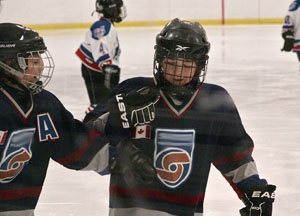
Being involved with minor hockey as a young boy, and now as a dad, I am witness to more than my share of the sheer stupidity of parent (both moms & dads, friends & fans) who celebrate the violence with more enthusiasm than they do for a strong play. It’s to the point that those involved with teams are required to take special training to address the issue. The game is amazing, but the raw violence has gotten out of hand. Sport is not a war; the goal isn’t to wipe out the opponent. The point is to out-play the opponent today, and try to do it again tomorrow.

I know the business argument of professional sports clouds the issue. NHL hockey is sport as entertainment, and the revenues rule decisions. But the ‘stay-out-of-my-sport-if-you-don’t-like-it’ goon mentality is selfish and myopic, not to mention naive. Beyond an economic driver, sport serves a role in community and society. We owe it to our children to protect the skill and excellence of a game well played from the lowest common denominator of violence as a means-to-an-end in any situation, where only the winner walks away.

We owe this to our kids at every level of the game, from Timbits™ to All-Stars. We’re not only protecting the game, we just might be protecting their lives.

Posted in Sports, That's Not Right, Values | Tagged , , , | 8 Comments

It’s not a job.

We need to change the parenting rhetoric that has gotten a lot of attention this week. Raising children is important, but parenting is not a job—it’s a part of the human condition.

That is not to imply that it requires no ‘work’ or ‘effort’. Parenting is incredibly hard work at times. And it’s not to imply that parenting has no value—the social values of the community are so intertwined with parenting that the monetary value of doing it well is almost completely intangible.

But the parenting rhetoric causes a problem when it distract the conversation away from other issues. Important issues. The Romney v Rosen fiasco is a perfect example. One person claims that the other has never worked a day in her life; a ridiculous notion if you consider parenting ‘work’, but not if the context is based on one’s record of employment (the truth of which I am uncertain). The argument is confusing ‘effort’ with ‘employment’; doing something because it needs to be done vs choosing to be compensated for doing something for someone else, at an agreed value.

A slip of the tongue—and a twisting of the meaning—caused people to ignore the issue of one person’s understanding of the economy in a political debate, and turned it into a class-culture-gender war. The soapbox rhetoric clouds the real issue at hand. An important issue. Accusations and semantic tap-dancing hijack the conversation, distracting the debate. And I believe people who grasp at any opportunity to support their own agenda do more harm than benefit to their cause.

The value of parenting gets platitudes of support instead of true respect, dismissing the distraction more than changing perceptions. The rhetoric must stop.

Being a parent isn’t a job. I am not employed by my child. I can’t be fired or laid off. I can’t be replaced by someone more skilled when my performance is questioned. I can’t find a child more suited to my parenting style when our missions don’t align.

To call being a parent a job was an argument to assign value to the work of raising kids, and it’s a critical issue in the feminist/modern family movement. It’s an easy way to connect effort and value in a way that makes sense to people, while also drawing an awkward line-in-the-sand between breadwinner and homemaker. But the “it’s a job” metaphor is an argument that has run it’s course, and we need to shelve it if parents—both at-home and those who are employed—want respect in discussions about other issues, such as the economy, gender equality, the definition of family, the 1% vs 99%, or any other issue facing society.

Parenting is important, and no doubt takes more effort than most jobs (and certainly more continuous attention than any job). But to imply that someone who is a parent has a “job” gives the neanderthals fuel for their out-dated beliefs about homemakers. It’s too easy to dismiss the importance of a committed parent when the comparison to a job lacks equivalence. It’s too easy to dismiss a partner as an employee, not as, …well, a partner.

You can’t hire a parent. You aren’t legally entitled to take a holiday from being a parent. You can’t employ the emotional connection—the unconditional love and commitment—that is at the very foundation of being a parent.

It’s not a job. It’s far too important to be as simple as job.

Posted in Culture, Current News, Inspirations, Thinking Differently, Values | Tagged , , , , | 5 Comments

Winning. Losing. Trying.

I’ll admit it; I like to win. After a well fought battle of skill and strategy, victory is sweet.

I also don’t mind losing. It’s not as sweet, but as long as everyone played fair, I will respect the victor. And I generally try to learn something from the defeat.

Unfortunately, children today aren’t allowed this sense of accomplishment or challenge. It doesn’t matter if it’s team sports or an individual effort, with young children there are no winners and no losers. We don’t keep score; we don’t keep stats. We no longer assign first place. Losing is hard, so winning is bad.

Organized sports groups and schools are removing aspects of winning or losing–different elements depending on people’s attitudes and experiences—in an effort to improve the ‘sporting’ experience for everyone. What’s left is a shadow of the skills, wrapped up in a false sense of fairness and fun, with the goal of making sure everyone is happy. But well-meaning adults are confusing happy with winning and assuming defeat automatically equals sadness.

I know there are plenty of experts who claim that winning and losing is harmful to children’s development. Being an active participant is more important, and kids who lose don’t want to take part, develop low self-esteem, and resent the winners. I don’t disagree with the science, but I think society’s response has affected the wrong part of the equation.

I believe we’re cheating our kids because we aren’t properly defining winning, losing and trying. We aren’t teaching our kids the value of sport and competition. Instead, we’re hiding from embarrassing behaviours.

Losing isn’t for losers. Kids need to learn that they won’t win all the time. Losing is a valuable life lesson. Learning how to lose honourably today and then give 100% again tomorrow will serve children well in many of life’s situations. But to deny kids the win—to deny them the sense of accomplishment as a result of honest effort—is wrong.

Winning is only for a moment. Tomorrow is a different competition. Winning is also a valuable lesson; the reward for persistence, practice and growth. And for as much as kids learn to lose, they also need to learn how to win. The victor needs to learn how to revel in a sense of accomplishment without diminishing the skill of the opponent. In turn, to shelter the opponent from a loss—to deny them the respect earned from an honest effort with the motivation and challenge to try again—is wrong.

When I coached U7 soccer in the community, we we’re told not to keep score. In reality, the parents pretended to ignore the number of goals while the kids knew the score exactly. Through the season, I found it challenging to help 6 year olds learn the sport and the different skills required, and to play with eagerness and enthusiasm, all in quest to score a goal—but the goal didn’t matter. Let’s be honest, parents don’t cheer a solid pass or a strong throw in with the same enthusiasm for a ball in the goal. There are no hi-fives for a smooth corner kick. (Ironically, at the pro level—where goals matter and are counted—there is also tremendous respect and analysis for the finer skills.)

This is the same story everywhere, from organized and community sports to school activities. Merely participating is the accomplishment; excelling is wasted.

Competition is a moment in time. It is a combination of activities—skills and circumstances—with clear rules and objectives. Players enter into each competition having practiced and trained, knowing that the outcome is yet to be determined. All the competitors have an equal chance to win or lose. The point is to try. The fun is in trying.

I recently participated in a safety training program for Hockey Canada, and the instructor shared some wonderful wisdom. Kids on his team were badmouthing the other team before the game. “Hate” was the word they were using. His response to those kids was beautifully simple: “Without the other team, there is no game. You can’t hate them. You need them.”

We need to teach kids to respect the competition as the place to test your skills. We need to remember that winning and losing are just outcomes, and the thrill of competition—the thrill of learning new skills and testing them in action—is an incredibly valuable lesson for all kids. We need to honour winning, losing and trying.

One last thought. I believe that the reason schools and parents push to reward participation equally has more to do with encouraging physical activity (health) than preventing discouraged athletes. I believe our kids know this, too.

Posted in Adventures, Culture, Sports | Tagged , , | Leave a comment